Wednesday, October 7, 2009
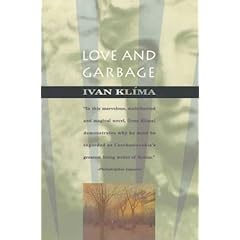
Love and Garbage
His past came to his mind, that he spent a year as a visiting professor in the United States. The president of Ford invited him for tea and the writer, a professor in American literature then, asked the president how they dealt with the deserted cars. Where did they go? The president found the question amusing and assured the Czech writer that the used cars would be recycled, no fuss and no worries. The writer now realize that it was not true. All cherished goods become garbage and wait for people to collect; things do not vanish, they degrade and become garbage. That is what he is now, the writer conveys it subtly, that he is garbage too. Disposable.The writing is melancholy with acceptance. Knowing that everything ends up become garbage, he pursues love nonetheless. He hurts people, his wife and his mistress, and they hurt him too, in a quiet, inevitable way. It is inevitable, yes, inevitable, that is the source of his acceptance of his situation. You can not stop milk going sour. Everything is garbage.
Notes from the book:
I think of her only as "she". In my mind I mostly do not give her a name. Names get fingered and worn just like tender words.
Do you think every love indulges in false hopes? she asked.
I realized that she was asking about us, and I dared not say yes, even though I could see no reason why we should be exceptions.
I wanted to fall asleep but I could feel the night creeping around me softly, like a cat out hunting, nothing mattering to it except its intended prey.
Listening to other people's tales, I sometimes feel like a debtor, like an eternal dinner guest who never offer any invitations himself, but usually I can not bring myself to demand the attention of others.
I'm having every sentence I utter examined by a guard dog. I've accommodated a whole pack of them within me. I pick my way between them, their barking at times deafens me and their their soundless footfalls frightens me in my dreams. Read More......
Tuesday, January 6, 2009
Notes of Great Jones Street
Simply clips from Great Jones Street that I admire a lot. Couldn't think of any remark other than "wow". Technorati Tags:don delillo, great jones street
I knew Azarian would assume leadership of the band, his body being prettiest.
There was soup to eat when the old stove worked. Things functioned sporadically; other things functioned all the time but never to full effect.
The little radio made its noises, fierce as a baby, never listening to itself.
An infinite number of monkeys is put to work at an infinite number of typewriters and eventually one of them reproduces a great work of literature. In what language
I don’t know. But what about an infinite number of writers in an infinite number of cages? Would they make one monkey sound? One genuine chimp noise? Would they eventually swing by their toes from an infinite number of monkey bars? Would they shit monkey shit?
I’m the one who works. I want my money to sit quietly. That’s my idea of the value of money. While I work and sweat, I want to think of my money resting in a cool steel-paneled room. It’s stacked in green stacks, very placid and cool, resting up.
People who travel a great deal lose their souls at some point. All these lost souls are up there in the ozone. They get emitted from jet aircraft along with the well-known noxious chemicals. There’s a soul belt up there.
This professorship deals with events that almost took place, events that definitely took place but remained unseen and unremarked on, like the action of bacteria or the rising and falling of mountain ranges, and events that probably took place but were definitely not chronicled.
I thought of all the inner organs in the room, considered apart from the people they belonged to. For the moment of thought we seemed a convocation of martyrs, visible behind our skin. The room was a cell in a mystical painting, full of divine kidneys, lungs aloft in smoke, entrails gleaming, bladders simmering in painless fire. This was a madman’s truth, to paint us as sacs and flaming lariats, nearly godly in out light, perishable but never ending.
Live strawberries instead of strawberries on tape.
Suicide was nearer to me than my own big toe.
I’m luggage. By choice, inclination and occupation. What am I if I’m not luggage? I open myself up, insert some very costly items and then close up again and get transported to a timeless land.
Let the stress of trying to live determine how you die.
I’d be happy to consume the dregs from an old cup that’s just lying around unwashed.
I began to feel that the bed was having a dream and that the dream was me.
Stand there and move your lips. Don’t think of it as a performance. Think of it as an appearance.
You betray a friend and then you brag about it. That’s star quality. That gives you stature.
The perfect suicide is when people know you’re dead on one level but refuse to accept it on a deeper level.
Wednesday, September 24, 2008
Turtle Diary
In the beginning, Turtle Diary is like a disoriented murmur from under the sea. Russell Hoban writes about turtles, water-beetles, oyster-catchers, whales, and throws irrelevant knowledge about them at his readers. Surviving the first 50 pages, the reader will find a structure that emerges as two loners hold the same thought of rescuing sea turtles from the zoo. Since they are one man and one woman, a romantic encounter is expected given the prevalence of heterosexual presumption. Technorati Tags:russell hoban, turtle diary
I enjoyed the narration when I waited for the two loners to meet. Their minds cross each other’s in the indifferent, anti-social thoughts, featuring self doubt and confusion. That is not the best formula for a romance.
I slowly got to understand the meaning of freeing the turtles when I waited for the romantic action to be taken or whatever plot it might be to bring the two loners closer. Putting turtles back to the sea is an attempt of the loners to free themselves from their dull life. They feel like a loser in their middle age and they need a drastic change desperately which preferably does not really change anything. A gesture would be just fine.
But they are difficult people. It is too simple and too easy. Before actually doing it they hesitated and soon they revealed their awareness of the hypocritical nature of such a self-righteous move.
It turned out that it is not about the turtles. It is not a romance of two like-minded loners either. It is dialectics of going back and forth between possessing something to reassure one’s existence and releasing one’s grip of something to achieve one’s own freedom. It is unlikely to be answered by either this or that. Like most questions of life, it is possibly a matter of a combination of this and that. And a perfect life is to go back and forth to find a balance.
Quotes I like:
“Polperro seems to me like a street-walker asking for money to maintain her virginity.”
“The ends of things are always present in their beginnings.”
“When a ewe licks a new-born lamb all over I believe that’s called owning it but the ewe never really owns the lamb.”
“I looked at the telephone after I’d put it down. Sly thing, getting words out of me I’d no intention of saying.”
“I’ll never cease to be amazed by the fact that people uncomfortable in themselves can give comfort to other people.”
“She looked heavily understanding, which irritated me. I felt there wasn’t anything to be understood.”
Tuesday, June 10, 2008
Why "Why Taiwan?"
Several things bothered me and they eventually made their way to this blog. Technorati Tags:taiwan, china, why taiwan,chinese nationalism
1. Type "中國 台灣" (China Taiwan) in Google's search and you'll get a website claiming to be non-governmental, at www dot chinataiwan dot org. It deals with the news about Taiwan but it's done according to China's imagination instead of facts. Everything about Taiwan is put in the frame of being a province of China, and it goes so far as to list the leaders Wen Jiabao, Hu Jingtao, and PRC's national flags as well as other symbols in the section "political system & state organs" of Taiwan.
The website is full of lies yet it ranks as number one in Google. That's no surprise because according to the Washington Post, the total number of Internet users in China exceeded those in the U.S. and became the largest in March 2008. Chinese internet users link to each other and they are able to boost any dishonest website to number one. For this reason the address of the above-mentioned website is not given as a link. I don't want to contribute to its spreading.
2. Taiwanese students in Germany complain that some of them were noted as Chinese on their visas when they requested an extension. They tried to explain to the officer but it seems that it's pure luck that determines what they get. The same person might get a "Chinese" notice this time and a "Taiwanese" notice next time though he gave the same document and argument.
3. In the Chinese eMule website VeryCD, when you register you'll have to agree to PRC's laws which forbid "to encourage the subversion of the PRC government or socialism", "to compromise the unification of the peoples and encourage the cession", or "to impair the reputation of the country," etc. These authoritarian laws are used to deprive people of their freedom of speech. Taiwanese used to have similar ones but we got rid of them so I didn't register because I don't feel like bending to them. Some Taiwanese did and I see their IDs are with a small flag. That's the flag Taiwan was forced to use in the Olympic Games. Needless to say, all other nationalities get national flags in their IDs. And needless to say, when I searched for the documentary about Hu Jia, an AIDS activist arrested and convicted by the PRC; or "The Gate of Heavenly Peace (Tiananmen)", the results are all irrelevant items.
4. EU refused to sell weapons to PRC after 1989 but now as time goes by and China's economy rises, EU is considering doing it.
5. Bush administration borrows so much money from China so now China owns the U.S.
6. When Ma Ying-jeou was elected as president, all English newspapers focused on the possible improvement of the cross-Strait relationship; and when Chen Shui-bien was heavily criticized, it was interpreted as a failure caused by his aggressiveness on the independence of Taiwan. So it seems that Ma's success and Chen's failure is evidence that the Taiwanese are in favor of a closer relationship with PRC, which I think is misleading. Ma's success comes from his reputation of being clean and decent, and Chen's failure results from his arrogance and corruption. Some media such as NPR don't have a correspondent in Taiwan and the news of Taiwan is covered by their correspondents in China, which partly explains the pro-China frame and its blind spot of Taiwanese perspective.
And more, and more. The Chinese-speaking world is dominated by Chinese nationalism and censorship. The censorship is not only executed by the government but also supported earnestly by numerous Chinese "netizens": some of them leave messages expressing hatred, some of them post information of dissidents online and encourage harassment against these individuals, and some of them attack the server to paralyze the website. Psychologically China is stuck in the early 20th century when it was invaded by western countries and Japan. This is a person suffering from child abuse and now has grown into a giant, but still traumatized by the powerlessness in his childhood. It's a recipe for disaster when a powerful person fails to recognize the power he has now and feels righteous due to the pains he suffered.
It deserves sympathetic understanding. China has not got the justice it deserves. Compared with Germany who has reflected on the sins of WW2 in an almost masochistic way, Japan basically pretends nothing happened. The hatred between Asian countries is pretty much in the present tense. It could be the future tense if the luck goes against us. China itself had been an imperialist force before its misery. It became a victim of western and Japan imperialism and as a result, the imperialism of China has never been reflected upon. The kid was a bully before he was abused, but how can you hold the abused kid accountable for what he did before? The thing is, the grown-up seems to try to restore his life so he can again freely bully his neighbors.
The imperialism of China could be, if the luck goes against us, the future tense too.
Due to the huge difference between Taiwan and China in terms of the population and political power, I am pessimistic about the communication in the Chinese-speaking world. I notice that some Taiwanese websites try to exclude users in China in a subtle way. Some write Chinese with a lot of Taiwanese dialect, some don't allow the users to register with email addresses from 126.com which is popular in China, and some ask for posting done in Chinese traditional. But even if all Taiwanese come to speak the same thing, sigh, compared with 1.3 billion Chinese, it is still like a drop in the ocean.
The English-speaking world might be worth a try. It is not flooded with Chinese nationalism and might be more accommodating to dialogue and debate on the cross-Strait issue. The lack of understanding seems to be easier to tackle, compared with interest conflict; that's why I do the excerpts of "Why Taiwan?" Maybe it's not any easier, but it's something that a hermit crab like me can do.
People say that the Internet makes us to be able to shout louder but we don't know if others are listening or not. Well, who knows with this kind of thing. But what the heck, I'll shout and see.
I am not a nationalist and I don't fancy to be one. Taiwan is part of my existence and I don't appreciate it to be distorted, misinterpreted, or lied about. I have every right to use the national flag; it's my freedom to hang it up or to set it on fire.
I am writing here not as a fundamentalist in the independence of Taiwan, not as a Taiwanese nationalist, not as a patriot, not as a partisan, not as a supporter of the government (whichever), but as a sexual, political, and sexual political dissenter, who does not reduce her life to politics only.
Friday, June 6, 2008
Notes on Why Taiwan: (4) Conclusion and comments
This is not the conclusion of the whole book but serves well as the concluding points of the parts that I cited in previous posts. Technorati Tags:taiwan, china, alan wachman, why taiwan
"As Tu Wei-ming writes, 'Educated Chinese know reflexively what China proper refers to' and are deeply imbued with the idea that 'geopolitical China evolved through a long process centering around a definable core.' Taiwan, though, was never part of that definable core. It was swept into the Chinese orbit only after Dutch and Spanish aggressors expressed interest in its potential as a base from which they might engage China in international commerce, gaining advantage over the Portuguese who occupied Macao (p.42)."
"Indeed, one scarcely risks provoking objection by observing that Beijing has invested far more political capital in pursuit of its claims to Taiwan than it has in most of the territorial disputes it settled with neighbors... One does not regularly read or hear, for instance, that the future of China's 'rise' and development depends on recovering sovereignty over Diaoyutai, the islands in the South China Sea, or the territory that India governs as part of the state of Arunachal Pradesh (p.29)."
"If Taiwan is valued in part because of its geostrategic salience, then every act by the United States or Japan that Beijing interprets as encouraging or exploiting the autonomy of Taiwan is a strike at the heart of the PRC's sense of security (p.162)."
"Taiwan's people seek the dignity of sovereignty and the assurance that so long as they do no harm to the PRC, Beijing will regard the island with neighborly comity. However, the geostrategic perspective leaves adherents in Beijing-- like the sailors Odysseus ordered to fill their ears with wax-- unable to or unwilling to hear Taiwan's plea in any way other than as an insidious challenge to China's future that must, without concern for cost, be overcome (p.164)."
Published in 2007, Why Taiwan received two book reviews: J. Bruce Jacobs in China Journal and Robert Green in Taipei Times. Both are favorable to Wachman's use of the historical material to argue successfully that Taiwan was not part of China. Robert Green has a funny comment:
"At the heart of this reading is the idea that relative strength dictates the imagined geography of security planners and the desire for a greater sphere of influence. Historically, this is a telltale of an expansionist power. As a nation's military capacity grows, so does its appetite for influence. Suddenly, ever-more-distant 'buffer zones' are necessary for security, and often far-flung geographic locations take on an immediacy and vitality for a nation's defense. Lord Salisbury, prime minister of Great Britain during the height of its imperial expansion, once quipped that his military advisors, if they had their way, would 'garrison the moon to protect us from Mars.'"
Tuesday, June 3, 2008
Notes on Why Taiwan: (3) 19th-20th century
Continued: On Chinese elite's indifference toward Taiwan in 19th and 20th century Technorati Tags:taiwan, china, alan wachman, why taiwan
June 2, 1895, Taiwan was ceded to Japan.
"Taiwan, it seems, was not simply 'lost' to Japan, but expunged from the ruling elite's mental map of China (p.69)."
"However, despite vigorous resistance to Japan's occupation that persisted on Taiwan for five months after the cession of the island, Qing court disavowed interest in the fate of the island, turned its back on local efforts to fight Japanese occupation, and resumed diplomatic relations with Japan on June 22. Whether the Qing foreign policy establishment perceived no responsibility or was simply overwhelmed by a sense of futility in the face of Japan's superior military power is hard to know (p.69)."
"Harry Lamley argues that the Qing was willing to let Taiwan go so long as it was ensured that the Liaodong peninsula remained part of China. There is also a myth, concocted perhaps by Li Hongzhang's detractors, that Li had all along aimed to rid the Qing of Taiwan because it was a difficult place to administer. This theme is highlighted in the recollections of the man who, in 1895, had been Japan's Vice-Foreign Minister, Hayashi Tadasu. Hayashi [a typo as 'Hitashi' in the original text] wrote that Li had shrewdly 'surrendered nothing which he was not prepared glad to get rid of, except the indemnity. He always considered Formosa [Taiwan] a curse to China... (p.188)'"
"In Japan, Liang [Liang Qichao, a leading Chinese intellectual who took part in the 100-day Reform in 1898] was sought out by a leading Taiwanese activist who hoped to receive advice about a strategy for resisting Japanese colonialism. Rather than to offer encouragement that resistance should be supported by the Chinese government, Liang preached moderation and made clear his view that Taiwan should not expect support from China (p.188)."
"Nevertheless, 'no Chinese government - Qing Empire, Nationalist Republic, or Communist Soviet - had a realistic chance of restoring sovereignty over the island, and no leader of these entities made Taiwan a major issue in domestic politics or relations with Japan. Simply put... few politicians even considered the island, much less devoted resources to its return (p.70, Wachman quotes from Steven Phillips).'"
Till the end of the WW2 was expected, China claimed the ownership of Taiwan.
"The decision to claim Taiwan was made sometime in 1942, after Japan's attack on Pearl Harbor in December 1941 and the declaration of war by the United States. The entrance of the United States into the war and the prospect of a transition in the balance of power in Asia may have encouraged China's leaders to envisage for the first time that Japan would be defeated (p.70)."
"Before that moment, though, the public attitude of Chinese Nationalist leaders toward Taiwan can only be characterized as indifference (p.70)."
Detailed evidence of the indifference is offered below.
"When in September 1900, Sun visited Taiwan, local opponents of Japanese colonialism were still locked in an armed struggle against Japan, and yet Sun apparently did not make any efforts to meet with activists on Taiwan who were fighting to alleviate colonialism (p.71)."
"Sun apparently regrets, but does not contest, the cession of those territories in the first list. There, Taiwan is equated with Burma and Vietnam, neither of which have been the subject of anything more irredentist than comparatively limited boundary disputes (p.72)."
Dr. Sun Yet-sen in a 1923 interview with New York Times considers China and Taiwan as different entities.
"If Taiwan had then been viewed by Sun as part of China, he might not have spoken of a difference between Taiwan's master and China's. He might have specified that in Taiwan, China had one master, but on the continent it had several. He did not do this, though, because it seems he did not view Taiwan as part of China's territory (p.72)."
"Dai Jitao, one of Sun's confidantes, wrote in march 1925, that twenty days before Sun died he spoke of three measures Japan should take to reestablish the confidence of people in China and East Asia. According to Dai, Sun advocated that japan grant complete autonomy [initial emphasis] to the peoples of Taiwan and Korea. Had he viewed Taiwan as Chinese territory, he might have expected that Japan return the island to China (p.73)."
Chiang Kai-shek did not claim Taiwan until 1938.
"It is noteworthy that he said, 'we must enable Korea and Taiwan to restore their independence and freedom, and enable them to solidify the national defense of the Republic of China (emphasis added).' That is, Taiwan and Korea- freed from Japanese occupation- were depicted as enhancing the security of China (p.75)."
Till 1942 there was the pledge that Taiwan should be emancipated and returned to the "mother country".
In 1943 in Cairo Crucible, Roosevelt pledged Chiang to take back Taiwan but Robert Dallek considers it "an outgrowth of Roosevelt's tender manipulation of Chiang Kai-shek (p.77)."
"Evidence of new thinking about Taiwan came from a variety of sources. Owen Lattimore, Roosevelt's adviser to Chiang Kai-shek, reported in August 1942, 'if any western power wants Formosa, the Chinese will claim it, but otherwise they may not insist on possessing it, since they lack the sea power to hold it (p.79)."
In 1943 Chiang published China's Destiny.
"Taiwan is among those territories that Chiang sees as offering a buffer, 'safe-guarding the nation's existence.' (p.80)"
As to elites of Chinese Communist Party (CCP), the attitude is not much different.
CCP was founded in 1921 and in 1922 CCP released a manifesto stating seven major tasks.
"[5] Use the free federal system to unify China proper, Mongolia, Tibet, Muslim Xinjiang in order to establish a Chinese Federal Republic (cited from Wachman, p.83)."
"It is noteworthy that Taiwan was not mentioned. Perhaps the CCP elite also accepted that the Treaty of Shimonoseki was binding and Taiwan's loss permanent (p.83)."
In 1928, Taiwanese is listed as one of the "minority nationalities" among Mongols, Muslims, Koreans, Miao, Li, and peoples of Xinjiang and Tibet.
"While the CCP was later to emphasize that Taiwanese are not a separate nationality but are Chinese, in the first decades of its existence, 'the CCP never referred to the Taiwanese as [brethren] (dixiong), or [the offspring of the Yellow Emperor], or [compatriots] (tongbao).' When they were not categorized by the CCP as a national minority, Taiwan's population was associated with the same category as the Koreans and the Annanese [Vietnamese], all oppressed peoples. (p.83, Wachman quoted Hsiao and Sullivan, The Cinese Communist party and the Status of Taiwan, p.448)"
"A Central Committee notice of that era calls for the reassertion of Chinese sovereignty over Shandong and Manchuria, both then held by Japan. However, Taiwan-- also a Japanese colony at that time-- was not even mentioned (p.192)."
"However, rather than include Taiwan in 'the nation,' the CCP entreats adherents to 'Unite with the people who are opposed to Japanese imperialism (the laboring masses in Japan, the Koreans, the Taiwanese, etc.) as our allies, unite with all peoples and nations sympathetic toward the Chinese national liberation movement, and establish friendly relations with all peoples and nations who opt for a well-considered neutrality in the anti-Japanese war (p.84, Wachman cited from 'Wei kang-Ri jiuguo gao quanti tongbao shu', published in 1935).'"
"Early in his career, Mao Zedong associated Taiwan with Korea and Vietnam (p.84)."
Mao said this in an interview done by Edgar Snow, 1936:
"It is the immediate task of China to regain all our lost territories, not merely to defend our sovereignty south of the Great Wall. This means that Manchuria must be regained. We do not, however, include Korea, formerly a Chinese colony, but when we have re-established the independence of the lost territories of China, and if the Koreans wish to break away from the chains of Japanese imperialism, we will extend them our enthusiastic help in their struggle for independence. The same thing applies for Taiwan (Cited form Wachman, p.85)."
Zhang Guotao, Liu Shaoqi, Deng Xiaoping, and Zhou Enlai, all leading elites in CCP, expressed similar stance (p.87-89).
In a 1941 document, CCP made it clear that China should "recover all our lost territories by fighting to the banks of the Yalu River and driving the Japanese imperialists out of China", but kept quiet in the cast land ceded to Russia in 1858 and 1860 (p.89).
"The association of the people of Taiwan with those of Korea and Vietnam, not with those of China, is a characterization that consistently appears in the formal statements of China's communist leadership (p.90)."
"One cannot avoid the conclusion that the CCP and its principal leaders neither viewed the island of Taiwan as China's territory nor felt that it was necessary to incorporate Taiwan into China following the defeat of Japan (p.90-91)."
CCP changed its attitude toward Taiwan in 1942, and possible reasons are:
1. The Comintern considered Taiwan as Japanese colony and believed it deserve "complete independence" like all colonies. Taiwan Communist Party (TCP), therefore, was an affiliate Japanese Communist Party in Comintern, and not CCP. This stance might influence CCP. In 20s and 30s CCP challenged some doctrines of Comintern but it didn't try to contest on the inclusion of Taiwan. Comintern was abolished in 1943 (p.94).
2. Some Taiwanese went to China and advocated for the restoration of Taiwan as a province of China. "Where the TCP was devoted on the independence of Taiwan after the defeat of Japan, the noncommunist activists were urging the ROC government to restore Taiwan's status as a province of China, following the defeat of Japan (p.96)." These pro-China Taiwanese felt frustrated to learn the indifference from the Nationalist Party, and CCP might consider this to be a chance to extend the rivalry with the Nationalist (p.97).
"That the CCP changed its stripes on the matter of Taiwan independence strikes Michael Hunt as characteristic of a party that was focused on expedience, not consistency. He writes that sympathy expressed early in the CCP's history for the weak and oppressed peoples was discarded when inconvenient for the party to uphold this line. Simply, the party operated unapologetically out of political opportunism (p.98)."
Notes on Why Taiwan: (2) 16th-19th century
Continued: On how Taiwan entered (or did not enter) the imagined geography of China Technorati Tags:taiwan, china, alan wachman, why taiwan
"By the middle of the sixteenth century, though, economic opportunity, as well as 'push' factors along the southeast coast of China, impelled profit-seekers to flout Ming regulations restricting seagoing ventures and to enter into the vibrant oceanic trade that entangled Japanese, Southeast Asians, European, and, increasingly, Chinese merchants into the skein of commercial interactions (p.51)."
"Davidson writes that 'A formal cession of the island was now made, which, considering that the Chinese had no right to it and never claimed any, was probably not a heart-rending task for them' (p.53)." (referring to 1624)
"Emma Teng argues that the prevailing view of Taiwan inherited from the Ming was 'that it was [beyond the seas] (haiwei); and... that it belonged to a realm known as [Wilderness] (huangfu) (p.57)."
"Teng makes the case that negligible contact with Taiwan and scant knowledge of it contributed to the view that it was an untamed frontier (p.57)."
"She cites, as examples, The Record of the Naval Defenses of Fujian Province [Fujian Haifangzhi], in which it is written that Taiwan 'extends from the northeastern to the southeastern like a standing screen; it is the outer boundary for China's four [coastal] provinces (p.59).'"
"In this formulation, Taiwan is not 'Chinese' in the sense of being territory deeply enmeshed in the national consciousness. It became China's for instrumental, geostrategic purposes long after the concept of China's territorial heartland had established in the minds of Chinese elite (p.59)."
"Chronicles of the cross-Strait dispute ordinarily begin with the ROC-CCP rivalry of the 1940s and, occasionally, peek back at the cession of Taiwan to Japan in 1895 and, more rarely, review the Qing history of interaction with the island dating to the early seventeenth century. Most analyses of the contemporary controversy focus on the cross-Strait dispute as if it were bounded by a logic and history that is separate from China's contest over other territories and over the island prior to 1950s. It is not (p.67)."
"Taiwan is not simply an object of bilateral dispute between Beijing and Taipei that emerged from Chinese civil war, but is perceived by some analysts in the PRC as a struggle for security and power in the context of an enduring rivalry with the United States for hegemonic influence in the Pacific (p.67)."
Sunday, June 1, 2008
Notes on Why Taiwan: (1) introduction
Why Taiwan? Alan Wachman wonders, as many others, why China has such an interest in taking Taiwan? Some would say it's for the sacred territorial integrity of China, but China didn't pay equal attention to other areas such as Mongolia or Arunachal Pradesh where China had disputes with neighboring countries. Wachman argues that Taiwan is considered significant and inseparable for geopolitical reasons; "Taiwan matters not only because of what it is, but because of where it is (p.32)." Here are some quotes from the book Why Taiwan? Geostrategic rationales for China's territorial integrity. Technorati Tags:taiwan, china, alan wachman, why taiwan
"Taiwan is one of those tracts of earth that has a 'history of ambiguity'. It has changed hands repeatedly and has been the focus of recurring struggles over identity, sovereignty and control. For the most part, since the seventeenth century, it has 'been defined as a small part of something else.' Taiwan, as Steven Phillips notes, has been administered as an overseas possession of a European power (1624-1661), an independent kingdom (1661-1683), a prefecture of a province (1684-1885), a province of an empire (1885-1895), a colony of a rival empire (1895-1945), and a province of a republic (1945-1949) (p.45)."
"For most of China's recorded history, the Chinese elite was largely unaware that the island even existed (p.46)."
"Qing territory waxed during the seventeenth and eighteenth centuries, but waned from the nineteenth to the collapse of the dynasty in the early twentieth century. To state that the PRC now inhabits the territories of the Qing is misleading (p.49)."
"In the case of Taiwan, the dominant motive for expansion was not security, per se, but 'take it or it will be taken'. The Qing decision to take the island was justified by a policy of strategic denial intended to ensure that Taiwan did not fall into hostile, foreign hands and then become a threat to security (p.49)."
Thursday, April 3, 2008
Kawabata
Yasunari Kawabata, 1968 Nobel Prize winner. I read Thousand Cranes and Snow Country, not moved or shocked as I expected. His novels seem to be incomplete with interstice, like he opened the cage and had all the rats racing but couldn't get them back. His novels are out of his own hands and he failed to do something about it. Technorati Tags:kawabata, yasunari kawabata, nobel prize, japan, literature
Yet his short stories are great. It's neat and simple as Chekhov, but deviant with a Japanese touch. Here's my favorite: 'Canaries'.
It's a letter from a man to his ex-mistress. It goes like this.
Sorry I have to break our agreement to write to you. I can no longer take care of the canaries you gave me. I remember you bought them from different shops and kept them in a cage symbolizing you and me, and also a reminder, a souvenir. But they are dying now, because the person who feeds them, my wife, has passed away. I thought of the possibility to release them or sell them back to the store, but the former will kill them and the latter is a defection to your gift. The fact is, the canaries live till today as my memory of you is due to my wife's effort, that explains why I fell in love with you, madam-- My wife took the responsibility of daily life so I didn't need to pay attention to the difficulties and had the luxury to love. So madam, may I kill the canaries and bury them with my wife?
--An old entry from an old blog
The Lexus, Olive Tree, Globalization and Its Discontents
I read two books regarding globalization: The Lexus and the Olive tree, and Globalization and Its Discontents. Technorati Tags:globalization, thomas friedman, joseph stiglitz, imf,
The Lexus and the Olive Tree was well written, the author, Thomas L. Friedman is a journalist with a wide range of working experiences, and he is an exceptional story-teller. The title itself reflects his style: he uses the Lexus to refer to the trend of modernized, precisely-programmed technology, rapid-paced nowadays; and the olive tree refers to tradition, cultural beliefs and faith, ethnic heritage, etc. A sucessful path of globalization will require a balance between the modern and the traditional.
Friedman argues that globalization is a set of neutral principles, as well as an unavoidable trend; nobody is in charge of globalization, you will benefit from it if, and only if, you are able to follow the rules. You better be fast; no, you must be faster. You better make sure that your government steps aside from the free market and keep the information transparent as much as possible, or the hot money will disappear in a second and your stock market will collapse and everybody goes bankrupt.
So who's to blame if you lose everything in the process of globalization? Since nobody is in charge, it is no one else but yourself to blame. You should have developed a more democratic system and a freer economy so you have a chance to win the game.
To my surprise, Taiwan was seen as an excellent model of a well-adaptive country. In 2000 when the book was published, the author thought that Taiwan is number one in Asia regarding free press and democracy. As an insider I see flaws and injustice in our system, not to mention that China keeps casting a shadow over us.
There are people against globalization. But in Friedman's view, they protest to demand a bigger share, which in turn proves that globalization is a welcome trend.
It is quite a different vision in Globalization and Its Discontents. The title is a parody of Sigmund Freud's Civilization and Its Discontents. The author, Joseph E. Stiglitz is the winner of Nobel Prize in economy in 2001, and what he sees is that there is nothing transparent in the decision-making of the International Monetary Foundation (IMF), while the third world countries are constantly under the threat of being cut off from international aid for not offering enough information, i.e. not transparent enough.
He vividly describes how the IMF messed up with poor countries in Africa and Asia by coercing a standardized policy upon them. IMF demanded an African country to speed in privatization of banks ignoring the fact that most people there lived on agriculture and didn't know much about western banking system. As a result, there were 14 banks folded up in a year and the society was in a crisis.
The IMF is powerful because it is in charge of loans. Stiglitz points out that there were several bias in the thoughts of IMF: 1) They are over-optimistic about the market and over-pessimistic about the government, but even Adam Smith was never that naive about the free market. In fact, the very idea of IMF is to create a public force to intervene when the market doesn't work well, and that happens from time to time. But in reality what IMF did is to shove off any public forces and rely solely on the market.
2) The decision-makers of IMF are with backgrounds of finance and banking, so they care too much about inflation and too less about unemployment, but the latter is a social glue. A society with high unemployment rate will pay a high price in crimes, riots and other forms of splits.
In the economist's view, the globalization is not a neutral, impartial principles; the Department of Finance of the U.S. is behind the scenes of IMF. With good intentions, maybe; but wrong policy, and more importantly, wrong way to reach the conclusion.
Friedman is right about that we want globalization. But he may distort the goal of anti-globalization campaign: not to reverse the Lexus back to the olive tree; but to pursue a fair world where poverty is diminished.
--An old entry from an old blog, before Erasmus Mundus
Forever Barbie
I am reading Forever Barbie: the unahthorized biography of a real doll by M.G. Lord. It's about the history of Barbie, who's behind the doll and is it the reason women dying on diet, etc. I dislike dolls personally, it's too girlie. (For the same reason I don't like yoga until I learned that a butch friend is doing yoga and it does her good.) But it's fun to read M.G. Lord, as a Barbie's fan who owns the very original no.1 doll, to analyze the business. Technorati Tags:barbie, m. g. lord, feminism
I'm not sure if Lord thinks herself a feminist, be it yes or no, we all are familiar with the feminist critique of Barbie-- it's part of the propaganda for being slim. But what concerns me more is why women collaborate with the (harmful) idea? It will not change a thing if we put the blame on dolls, it's too easy. Men are ridiculed about their bodies too and they manage to survive it, transcend it and laugh about it.* It makes more sense to empower women in the same manner.
The book is fun in explaining the sizes. Why does Barbie's waist as small as a honeybee? The designer explains that Barbie wears "real" clothes, i.e. the same fabric and similar complexity as women's wear. In the waist, there will be 4 layers of fabric. And in Barbie's size, her waist will be wider than her hip with extra 4 layers of fabric; so they have no choice but make the doll in a drastic shape.
It could be a smart excuse, but who cares? It's a creative way to lie if it is one.
Another size issue is about Ken. They gave Ken a small size penis, unerected of course. Some suggested to have Ken's short painted on the doll, so little girls won't get scared or embarrassed when they undress the doll. Others said no, "You will see all the girls sit together trying to peel it off!"
--An old entry from an old blog
*added today. Dedicated to the victims of the heated comments about some of my dear classmates whom I won't name.
How Small is the World?
The science of networks doesn't sound interesting, but how about the idea that you are only six degrees away from anyone in the world? Nexus: Small Worlds and the Groundbreaking Science of Networks by Mark Buchanan and Six Degrees: The Science of a Connected Age by Duncan Watts deal the popular notion with scientific inquiry that help us to see the hidden desire and fear of our time. Technorati Tags:network, six degree, small world, nexus, duncan watts, stanley milgram, klienfeld, weak ties, mark granovetter,
Psychologist Stanley Milgram is the first scholar to bring up the "small world". In 1967, Milgram conducted an experiment in which he sent letters to 300 people in the U.S. and ask them to forward the letter to a designated target, a stock broker in Boston. To his and everyone's surprise, the average number of letter travel is six-- the world is much smaller than we thought! The idea of a small world got more and more popular and was adopted in a play and a movie.
Milgram had always been a controversial figure, but his flawed theory didn't get busted this time until 2002. Klienfeld examined Milgram's data and found that it was not random at all. There were 100 of them lived in Boston instead of alleged Nebraska; and another 100 persons were investors of stock who reasonably have a fair chance to know how to reach a stock broker. There were 96 persons out of 300 qualified as "random"; and only 18 among them successfully completed the assignment.
Milgram was proved to be defective, but the six degrees of separation survived. Duncan Watts applies mathematical approach on social network and supposes that six may be the right figure. But is a world with six degrees of separation a small world? Is six small at all? Watts says no, six is huge.
Start it from me, the first degree of separation would be someone I personally know, say, a friend Ling, a social activist devoted to migrant workers' rights. The second degree is one of her acquaintance whom I don't know, it could be a Philippine woman working in Taiwan. The third degree could be the father of the Philippine woman, a farmer or a coal-miner; and I can hardly go on because I am dragged to a world that I know almost nothing about and this is just the third degrees of separation. I will be easily connected to a Martian in the eighth degree.
Mathematicians who set foot in this sociological arena do acknowledge the fact that human network doesn't exactly resemble a piece of paper with a few dots on it. There are some factors to be known that segregate people into clusters, like class, gender, geography, language, etc. It turns out to be that the link between clusters is extremely powerful, sometimes determinant.
Here comes another fascinating concept: "the strength of weak ties", as Mark Granovetter called it. When looking for a job, your acquaintances will be more helpful compared with close friends, because your acquaintances are capable of taking this information to another "cluster" while your friends probably locate in the same cluster. Weak ties are especially important in creating a trend, a fashion, or a craze.
I wonder how many weak tie is used connecting two persons in six degrees of separation? None of the studies mentioned in these two books seems to answer this question. A weak tie is actually a giant leap between clusters, and the average number of weak tie may be an even better indicator than the number of degrees of separation.
Another interesting question would be the definition of "connection" or "link". In mathematics it's easy: You draw a couple of nodes and take a ruler to draw a line to connect them, you create connections or links. But human connection is more complicated than that: how weak is the weak tie? In psychological experiments mentioned above, they use the lowest level of interaction, which is the conveyance of insensitive information, and my assumption is that it could be the maximum load of a weak tie. Add a little debate on it and it will split-- that's what makes it a "weak" tie in the first place.
The prevalence of six degrees of separation is itself a phenomenon worthy of exploring. There seems to be little resistance since it was introduced. The idea of a small world is comforting when in reality we feel intimidated by the world's immensity and by people's indifference; we need a theory to tell us: in a mystical way we ALL are connected; nobody is alone although it appears to be so.
--An old entry from an old blog, before Erasmus Mundus